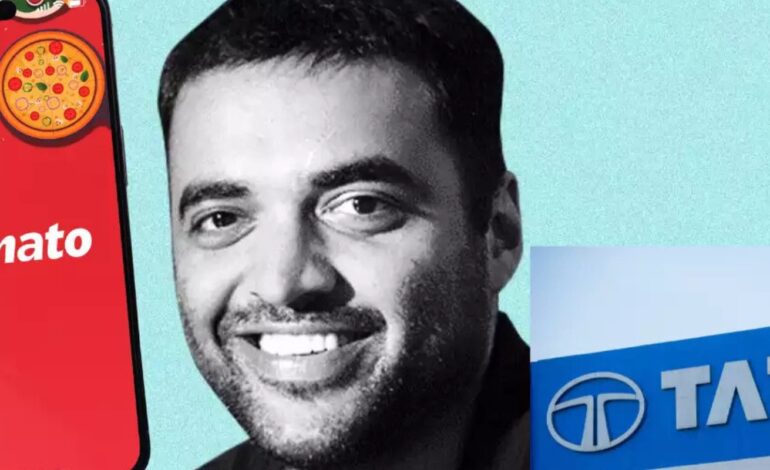
The Indian stock market witnessed a significant shift as food delivery giant Zomato, led by CEO Deepinder Goyal, surpassed Tata Motors and Bajaj Auto in market capitalization. This achievement is a testament to Zomato’s meteoric rise in 2024 and marks a new era where technology-driven startups are rivaling established industry giants.
With a market cap of approximately ₹2.83 lakh crore, Zomato has edged past Tata Motors (₹2.79 lakh crore) and Bajaj Auto (₹2.5 lakh crore). The company’s stock price has surged by an astonishing 162% in 2024, reflecting strong investor confidence and robust business performance.
The Numbers That Tell the Story
Zomato’s extraordinary growth this year has been driven by a combination of factors:
- Market Cap Surge: Zomato’s market cap has skyrocketed to ₹2.83 lakh crore, overtaking legacy brands Tata Motors and Bajaj Auto.
- Sensex Inclusion: Zomato is set to replace JSW Steel on the Sensex on December 20, 2024, further cementing its position as a market leader. The Sensex includes 30 top-performing companies based on financial health, market liquidity, and six-month float-adjusted market cap averages.
- Increased Investor Interest: The inclusion in the Sensex is projected to bring inflows of $513 million (approximately ₹4,356 crore) into Zomato’s shares, making it a darling of both domestic and international investors.
What Drives Zomato’s Success?
Zomato’s rise in market cap and stock performance can be attributed to several key factors:
1. Strong Revenue Growth
Zomato’s ability to grow its revenue base consistently has been a cornerstone of its success. Its core food delivery business has expanded to new markets, increasing its user base and order volumes. Additionally, its subscription-based Zomato Gold program has driven customer retention and loyalty.
2. Diversified Business Model
Beyond food delivery, Zomato has ventured into cloud kitchens, hyperlocal grocery delivery, and payment services. This diversification has reduced its dependence on a single revenue stream and opened up new avenues for growth.
3. Operational Efficiency
Zomato has implemented technology-driven optimizations in logistics and delivery, ensuring faster deliveries and better customer experiences. This operational efficiency has translated into improved profitability, making it an attractive investment for institutional and retail investors.
4. Strategic Investments
The company’s strategic acquisitions, such as the buyout of rival Uber Eats India in 2020, have helped Zomato consolidate its position in the competitive food-tech market. Recent investments in AI and machine learning have further strengthened its predictive analytics and customer personalization capabilities.
5. Global Expansion
Zomato’s foray into international markets has paid dividends, contributing significantly to its revenue growth. By targeting markets in Southeast Asia and the Middle East, Zomato has expanded its global footprint while mitigating risks associated with operating solely in India.
Zomato’s Sensex Debut: What It Means for Investors
Zomato’s addition to the Sensex is not just symbolic but also financially significant. The Sensex is a barometer of India’s economic health and a benchmark for investors worldwide. Inclusion in the index brings increased visibility and credibility, as well as heightened interest from institutional investors.
Key Implications:
- Increased Liquidity: Inclusion in the Sensex attracts index funds and exchange-traded funds (ETFs), leading to greater liquidity in the stock.
- Investor Confidence: The move signals Zomato’s maturity as a company and its ability to meet stringent financial criteria, boosting investor confidence.
- Potential for Stock Growth: Analysts predict that Zomato’s stock could rise significantly in the next year. Morgan Stanley, for instance, has set a best-case price target of ₹510 per share, a 75% upside from current levels.
What Sets Zomato Apart from Tata Motors and Bajaj Auto?
While Tata Motors and Bajaj Auto are stalwarts in the automotive industry, their growth has been relatively slow compared to Zomato’s explosive rise. The shift highlights the growing dominance of tech-driven companies in the Indian economy.
1. Technology-Driven Growth
Unlike traditional automakers, Zomato operates in a high-growth sector fueled by technology. Its ability to leverage data analytics, AI, and machine learning gives it a competitive edge.
2. Scalability
Zomato’s business model is inherently scalable, with lower capital expenditure requirements compared to automakers. This scalability allows the company to expand rapidly without significant physical infrastructure investments.
3. Changing Consumer Preferences
The rise of digital platforms like Zomato reflects changing consumer preferences toward convenience and on-demand services. In contrast, the automotive sector faces challenges such as regulatory hurdles, rising input costs, and a slow transition to electric vehicles.
Challenges on the Horizon
Despite its success, Zomato is not without challenges. The company must address the following issues to sustain its growth trajectory:
- Profitability Concerns: While Zomato has improved its margins, it still operates in a highly competitive and price-sensitive market. Achieving consistent profitability remains a challenge.
- Regulatory Risks: As a dominant player in the food delivery market, Zomato could face scrutiny from regulators, particularly regarding anti-competitive practices.
- Market Saturation: The Indian food delivery market is nearing saturation, with limited room for growth in urban areas. Expanding to Tier-2 and Tier-3 cities requires overcoming logistical and cost-related challenges.
- Global Competition: In its international markets, Zomato faces stiff competition from established players like Uber Eats, DoorDash, and Deliveroo.
The Broader Implications for India’s Startup Ecosystem
Zomato’s rise signals a broader shift in India’s startup ecosystem, where technology companies are now competing with legacy industries in market capitalization and investor attention. The milestone serves as inspiration for other startups, showcasing the potential for tech-driven enterprises to achieve unprecedented growth.
Key Takeaways for Startups:
- Focus on Scalability: Zomato’s ability to scale quickly has been a critical driver of its success.
- Invest in Technology: Leveraging AI, data analytics, and automation can provide a competitive edge.
- Diversify Revenue Streams: A diversified business model can reduce risk and unlock new growth opportunities.
Conclusion: A New Era in Indian Business
Zomato’s rise to surpass Tata Motors and Bajaj Auto in market cap is a defining moment for India’s tech industry. It reflects the changing dynamics of the Indian economy, where technology and innovation are becoming key drivers of growth. As Zomato prepares to make its debut on the Sensex, all eyes will be on its next moves in maintaining its leadership position in the fast-evolving food-tech market.
For investors, Zomato offers a unique opportunity to participate in the growth of India’s digital economy. However, the road ahead is fraught with challenges, and only time will tell if Zomato can sustain its remarkable ascent.
Source: Business Today