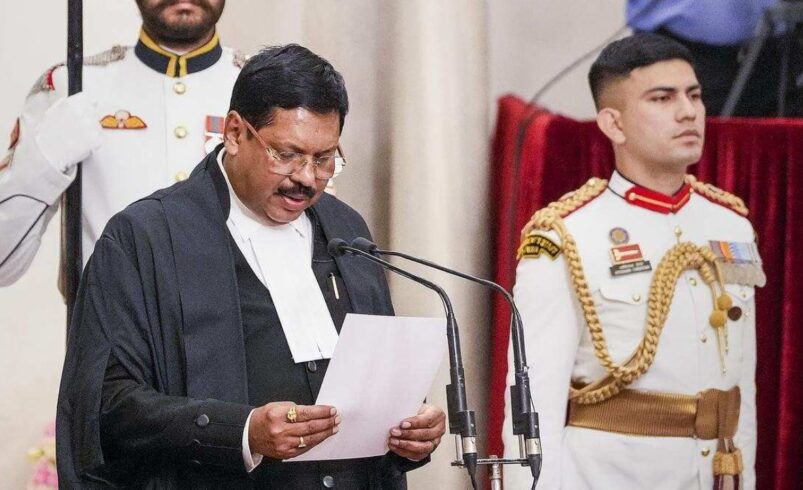
On May 14, 2025, India witnessed a historic moment as Justice Bhushan Ramkrishna Gavai was sworn in as the 52nd Chief Justice of India (CJI). Administered by President Droupadi Murmu at Rashtrapati Bhavan, the oath was taken in Hindi, symbolizing both inclusivity and regional representation. The ceremony was graced by a host of dignitaries including Prime Minister Narendra Modi, Home Minister Amit Shah, Defence Minister Rajnath Singh, and Law Minister Arjun Ram Meghwal. Also present were Vice President Jagdeep Dhankhar and former President Ram Nath Kovind, underscoring the importance of the occasion. Justice Gavai’s elevation marks not only a continuation of judicial excellence but also a progressive milestone in India’s commitment to diverse representation within its top constitutional institutions.
A Career Rooted in Legal Discipline and Public Service
Justice BR Gavai brings with him a wealth of legal experience, having started his career in 1985. Initially working with the late Raja S Bhonsale—then Advocate General of Maharashtra—he began independent practice at the Bombay High Court in 1987. Over the years, Gavai earned a reputation for his thorough legal interpretations and firm judicial ethics. He was elevated to the Supreme Court on May 24, 2019, and served on several important benches including Constitution benches that handled cases of national significance. His six-month tenure as CJI may be short but is expected to be impactful, as his previous judgments have demonstrated deep constitutional insight and a commitment to justice.
Representation and Inclusion: First Buddhist CJI from SC Community
Justice Gavai’s appointment holds social and symbolic significance, especially for historically marginalized communities. He is the first Buddhist to become Chief Justice of India and only the second person from the Scheduled Caste community to hold this office after Justice KG Balakrishnan. His father, the late RS Gavai, was a respected political figure, having served as Governor of Bihar, Kerala, and Sikkim, and as a leader of the Republican Party of India (Gavai faction). This lineage of public service and social reform resonates deeply with the principles of equality, justice, and representation, and serves as an inspiration for millions striving for social mobility through education and hard work.
Key Contributions to Constitutional Jurisprudence
Justice Gavai’s judicial legacy includes participation in several Constitution Bench verdicts that have shaped modern Indian legal discourse. Notably, he was a part of the five-judge bench that unanimously upheld the abrogation of Article 370 in December 2023, which revoked the special status of Jammu and Kashmir. His presence on such critical panels reflects the trust the judiciary places in his legal acumen. His interpretations of law have often blended constitutional morality with practical governance, making his judgments both impactful and enduring. As CJI, he is expected to steer the judiciary toward more inclusive and equitable justice delivery.
The Road Ahead for India’s Judiciary under CJI Gavai
Justice Gavai’s tenure comes at a crucial time for the Indian judiciary, with challenges ranging from pendency of cases to questions on judicial independence and public trust. With over six months at the helm, he is likely to focus on judicial reforms, digital access to justice, and strengthening institutional transparency. In his first remarks post-swearing-in, he paid homage to Mahatma Gandhi and Dr. BR Ambedkar—figures who laid the foundation of India’s constitutional democracy. These acknowledgments set the tone for a tenure that could blend legal excellence with social responsibility. As India’s top judge, Gavai’s leadership is expected to champion a judiciary that is fair, inclusive, and responsive to the aspirations of all Indians.
Get the latest in business, markets, startups, and policy—visit businessnewsindia.in for in-depth updates and follow us on Instagram @businessnewsindia.in for daily bites of what matters most.
Source : hindustantimes.com