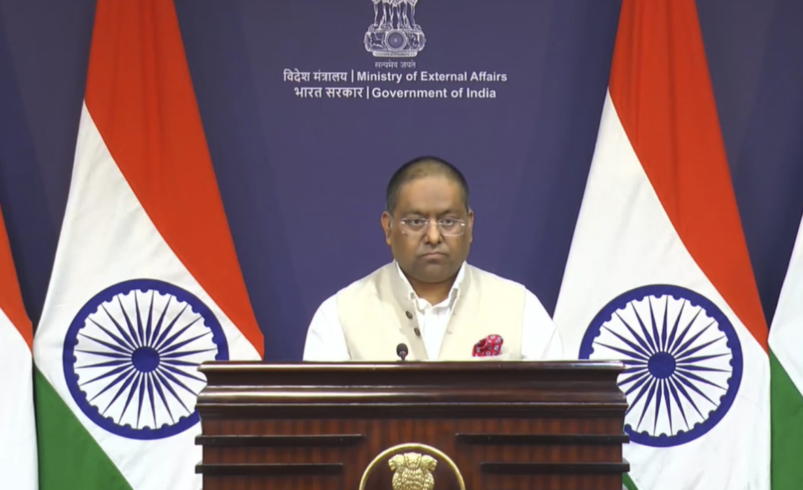
In a sharply worded statement, the Ministry of External Affairs (MEA) of India took a direct swipe at Pakistan’s premature claims of victory following recent military exchanges. MEA spokesperson Randhir Jaiswal mocked Pakistan’s narrative, saying that their tradition of declaring triumph even in defeat is well-known. “Parast ho jao lekin dhol bajao,” Jaiswal remarked, capturing the sentiment that Pakistan often resorts to loud celebrations despite military setbacks. His remarks came during a press briefing in which he addressed the ceasefire agreement reached after India’s powerful retaliation under Operation Sindoor.
Ceasefire Came After Pakistan’s Plea, Not India’s
Jaiswal confirmed that it was Pakistan that reached out to initiate the ceasefire—not the other way around. He said that the call for an understanding came from Pakistan’s Director General of Military Operations (DGMO) following heavy losses inflicted by India. This revelation counters Pakistan’s media portrayal that they had pushed India toward peace from a position of strength. Satellite images, according to Jaiswal, tell a very different story—highlighting damage on Pakistani targets compared to India’s intact installations. This fact, he asserted, clearly shows who sought peace first and why.
Historic Pattern of Misinformation from Pakistan
The MEA’s comments drew parallels between the current situation and past conflicts like the 1971 war, the 1975 Siachen dispute, and the 1999 Kargil War. In each of these instances, Jaiswal pointed out, Pakistan engaged in chest-thumping and misinformation to cover up its losses. This habitual narrative manipulation, he suggested, is deeply ingrained in Pakistan’s political and military machinery. The emphasis was not just on setting the record straight for the public, but also on exposing how such tactics are used to maintain internal morale and international sympathy.
India’s Firm Stand Against Nuclear Blackmail
Jaiswal reiterated India’s policy of zero tolerance toward terrorism and its firm position against nuclear threats. He clarified that Operation Sindoor was a conventional military response, carefully calibrated within international norms. He emphasized that India would not be blackmailed by nuclear rhetoric, a strategy often employed by Pakistan in moments of military vulnerability. India’s focus, he said, remains on targeting terrorism surgically and responding proportionally while maintaining moral and strategic clarity on the global stage.
The ‘New Normal’ in India’s Defense Doctrine
The MEA concluded by underlining that India’s posture toward cross-border terrorism has changed permanently. The days of limited responses are over, and every provocation will meet a resolute answer. Jaiswal stressed that international support has tilted in India’s favor, with many countries backing its right to self-defense. This evolving doctrine of assertive yet measured retaliation signifies a new chapter in India’s approach toward Pakistan. The message was clear: while Pakistan may continue to “beat the drums,” India is focused on facts, actions, and consequences—not performative victories.
Get the latest in business, markets, startups, and policy—visit businessnewsindia.in for in-depth updates and follow us on Instagram @businessnewsindia.in for daily bites of what matters most.
Source : hindustantimes.com