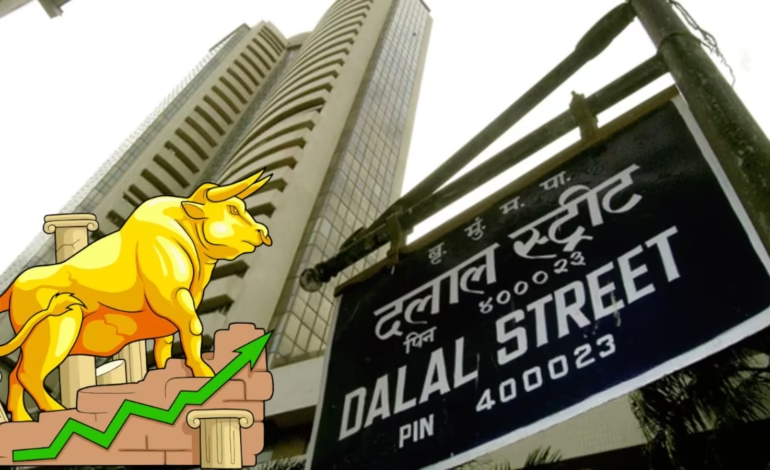
The Indian stock market rebounded strongly on Monday, December 23, 2024, after enduring a five-day losing streak. Benchmark indices Sensex and Nifty posted impressive gains, aligning with a global market rally. This rise is attributed to renewed investor confidence and favorable global cues. Let’s dive into the reasons behind this rebound and its implications for investors.
Sensex, Nifty Surge: Key Highlights
- Sensex Performance: The Sensex climbed 624.70 points (0.80%) to close at 78,666.29.
- Nifty Performance: The Nifty gained 153.10 points (0.65%) to settle at 23,740.60.
- Market Capitalization: The BSE market capitalization rose by ₹87,765 crore, reaching ₹4,41,86,982 crore.
- Top Gainers: Banking and financial heavyweights like HDFC Bank, Bajaj Finance, ICICI Bank, and Tata Steel led the rally.
- Notable Losers: Zomato and Sun Pharma witnessed declines, with Zomato dropping 2%.
Global Cues Driving the Rebound
The rebound in the Indian stock market was influenced by strong performances in global markets. On Friday, December 20, the US markets closed over 1% higher, with the S&P 500 futures advancing. Similarly, Asian markets in South Korea, Japan, and China mirrored the bullish sentiment, setting the stage for Indian markets to follow suit.
Another contributing factor was the weakening of the US dollar, which retreated from its two-year high after lower-than-expected inflation data in the US. This development eased concerns about aggressive monetary tightening by the Federal Reserve, further boosting market sentiment globally.
Sectoral Analysis: Banking and Steel Shine
- Banking and Financials:
Banking stocks were among the biggest gainers, with HDFC Bank rising 1.68% and ICICI Bank adding 1.21%. Bajaj Finance also gained 1.28%. Investors showed increased interest in financial stocks, perceiving them as undervalued after the recent market correction.
- Steel Stocks:
Steel companies Tata Steel and JSW Steel made notable gains. Tata Steel rose 2.09%, while JSW Steel climbed 3.21%. The Directorate General of Trade Remedies (DGTR) launched an investigation into safeguard provisions on steel imports, raising expectations of favorable policies for domestic steelmakers.
- Cement Sector:
Shares of India Cements surged 11% after UltraTech Cement received Competition Commission of India (CCI) approval to acquire a majority stake in the company.
Expert Opinions on the Market Rebound
Stock market analysts see this rebound as a natural pullback after a steep five-day selloff. However, they caution against interpreting it as the beginning of a sustained rally.
V K Vijayakumar, Chief Investment Strategist at Geojit Financial Services, stated:
“In the short run, there will be market rebounds which may be followed by renewed FII (Foreign Institutional Investor) selling. A sustained rally is possible only when we have indications of a growth revival in the economy, likely in early 2025.”
The reversal in FII flows was a key concern. After net purchases earlier this month, FIIs sold stocks worth ₹15,826 crore last week, reflecting a cautious approach amidst global uncertainties.
Technical Outlook: What Lies Ahead for Nifty?
According to ICICI Securities, Nifty’s recent decline of over 1,200 points brought the daily stochastic oscillator into oversold territory, indicating a short-term pullback opportunity. However, for a meaningful recovery, Nifty must decisively close above the 24,065 mark, its previous session’s high.
- Key Support Levels:
- Immediate support: 23,200 (November low).
- Final support: 22,900, which coincides with the 61.8% Fibonacci retracement level.
- Resistance Levels:
- Immediate resistance: 24,400, aligning with the 50-day EMA.
Akshay Chinchalkar, Head of Research at Axis Securities, highlighted the 23,400 mark as a crucial support level, adding that deeply extended downside momentum could lead to a strong rebound.
What’s Driving Investor Sentiment?
- Improved US Market Performance:
The strength of the US economy, robust corporate earnings, and expectations of a corporate tax cut under the Biden administration boosted global investor confidence.
- Domestic Valuations:
After the five-day selloff, many Indian stocks were perceived as undervalued, attracting buying interest.
- Policy Support for Key Sectors:
Government investigations into steel imports and strategic M&A activities, like UltraTech Cement’s acquisition of India Cements, added a layer of optimism for specific sectors.
Challenges Ahead: FII Selling and Economic Growth Concerns
While the market rally is a welcome development, challenges persist. The continued FII outflows underscore concerns about India’s economic growth and corporate earnings.
Vijayakumar pointed out the relative underperformance of Indian indices compared to the US market, driven by a Q2 GDP slowdown and stagnation in corporate earnings. These factors could weigh on investor sentiment in the medium term.
Investor Takeaways: Should You Stay Cautious?
Market participants are advised to approach this rally cautiously. While short-term gains are likely, the broader market trend will depend on:
- Sustained FII buying.
- Revival in GDP growth.
- Positive corporate earnings in the upcoming quarters.
Investors should focus on fundamentally strong sectors like banking, steel, and cement, which are backed by favorable policy developments and robust demand prospects.
Conclusion: A Temporary Respite or the Start of a Rally?
The stock market’s rebound on December 23 offers a breather after a challenging five-day period. With Sensex and Nifty posting significant gains, investor sentiment has improved, albeit cautiously.
Global factors, like the retreat of the US dollar and strong US corporate earnings, have positively influenced the Indian market. However, domestic challenges, including FII selling and sluggish GDP growth, remain.
As the year comes to a close, the market’s trajectory will depend on a mix of global and domestic factors. For now, investors are advised to remain vigilant, focusing on quality stocks with strong growth prospects.
Disclaimer: This article is for informational purposes only and should not be construed as financial advice. Investors are encouraged to consult with a qualified financial advisor before making any investment decisions.
Source: Business Today